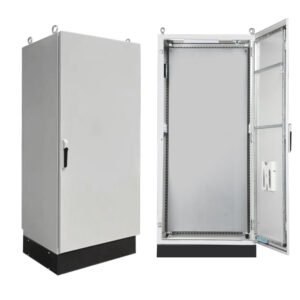













In the field of industrial automation, the PLC control cabinet serves as a central hub, essential for achieving equipment and process automation thanks to its compact design and reliable performance. This guide will walk you through the fundamentals of designing such a cabinet—from selecting components and programming to implementing safe wiring practices.
1) What’s a PLC control cabinet?
i) A PLC control cabinet is an electrical enclosure designed to house and protect automation control systems. It contains key components such as the central PLC unit, power supply systems, input/output (I/O) modules, and auxiliary electrical components. By shielding these elements from harsh industrial conditions—including moisture, dust, and physical impact—the cabinet ensures the reliable and stable operation of the PLC system.
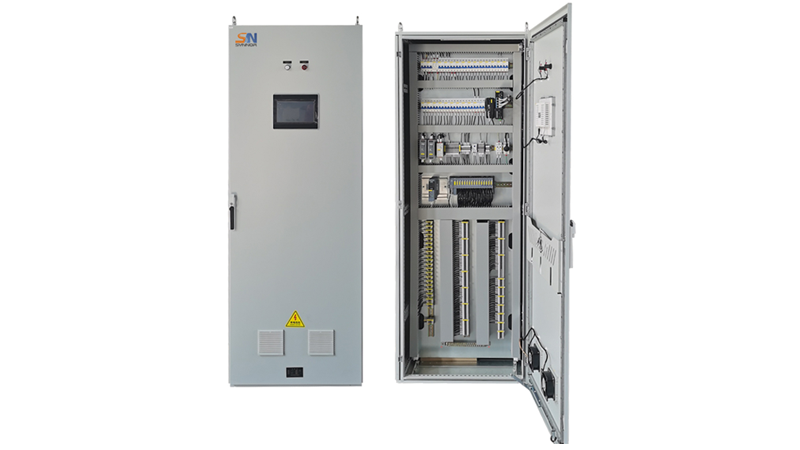
ii) Its core function is to receive signals from field input devices such as sensors and push buttons, process them through programmed logic and operations, and then send control signals to actuators—such as motors, solenoid valves, and indicator lights—thereby achieving automated control of industrial processes.
iii) Compared to traditional relay-based control cabinets, PLC control cabinets offer advantages such as greater programming flexibility, smaller size, and easier maintenance. Ability to quickly adapt to production process adjustments, significantly to enhance the level of intelligence in industrial control.
2) What’s the PLC cabinet core components?
The core components of a PLC cabinets mainly consist of five parts:
- Cabinet Structure: The cabinet serves as the mounting platform for all electrical components, primarily providing physical protection, electromagnetic shielding, and facilitating maintenance.
- PLC Main Module: It mainly comprises the Central Processing Unit (CPU), memory (ROM/RAM), communication interfaces, and programming interfaces.
- Power Supply System: Its function is to convert the AC power from the industrial site (typically AC 220V or AC 380V) into stable DC power required by the PLC and other electrical components, ensuring reliable power supply for the entire control system.
- Input/Output (I/O) Modules: These modules act as the “bridge” for signal interaction between the PLC and field devices. They are divided into input modules and output modules, enabling the conversion of analog and digital signals as well as signal isolation.
- Auxiliary Electrical Components: These are essential for expanding the functionality, ensuring safety protection, and facilitating wiring connections in the PLC control cabinet. They include relays, contactors, circuit breakers, fuses, terminal blocks, indicator lights and buttons, and Surge Protective Devices (SPDs).
3) How to design a PLC Control Cabinet for you?
Design a PLC control cabinet is not a single simple composition, need to consider all aspects of factors, the following guidelines you will be able to understand the design of the time need to pay attention to what aspects.
i) Confirm your project requirements
Prior to designing, it is essential to understand the project requirements: which parts of the system the PLC cabinets will control. This will determine the selection of components and the type of cabinet. In addition, the on-site environmental conditions, such as temperature and humidity, must be considered, as they will affect the choice of cabinet materials and protection requirements.
ii) Select components
After identifying project requirements, the first step in starting design work is to identify components, including:
- Circuit Breaker: A main circuit breaker serves as the power control for the entire cabinet.
- PLC: Selection is based on project needs. Small projects employ compact, all-in-one PLCs. Large projects demand modular or card-type versions, sometimes incorporating dual-set redundant configurations for maximum reliability.
- Power Supply System: Most PLCs feature a 24VDC power supply. Actual demands dictate the use of an external switching power supply. When AC fluctuations remain within +10% to +15%, the PLC accepts direct connection to the grid. A high-quality switching power supply offers advantages such as high efficiency, low ripple, and a wide input voltage range. A backup power supply offers additional security. Critical control scenarios in the chemical or power industries require a UPS (Uninterruptible Power Supply) to safeguard against data loss or equipment damage during sudden power failures. It automatically switches to backup power during outages, ensuring continuous operation of the PLC.
- I/O Modules: Input Modules can be divided by signal type:
- Digital Input (DI) modules accept on/off signals, such as button presses/releases.
- Analog Input (AI) modules accept continuously variable signals, such as temperature (0–100°C) or pressure (0–1 MPa).
- Input modules filter and isolate field signals, converting them into digital signals recognizable by the PLC.
- Output Modules are similarly categorized:
- -Digital Output (DO) modules provide on/off signals to control motor start/stop, solenoid valve switching, or indicator lights.
- -Analog Output (AO) modules output continuously variable signals, such as controlling inverter frequency or regulating valve opening.
- Output types of these modules mainly include relay outputs, transistor outputs, and thyristor outputs.
iii) Cabinet enclosure design and layout
Key considerations for determining cabinet dimensions and layout:
- Cabinet type selection: Use fixed cabinets with full-length doors (KB, nine-fold, or sixteen-fold) for PLC systems. Avoid GGD, split, or drawer cabinets. Because PLC components require full-size mounting panels, split-type enclosures complicate debugging and maintenance tasks.
- Cabinet ventilation system design: The cabinet ventilation scheme utilizes air inlets at the bottom of the front door and partial air outlets on the cabinet top. The design excludes any air inlets or outlets on the rear door. Ventilation filters cover both air inlets and outlets to block dust. If the cabinet emits minimal heat, natural convection suffices for cooling. If the cabinet emits more heat, it is necessary to speed up the heat dissipation wind speed. An axial fan can be installed on the outlet filter to exhaust the air outward.
- Internal Component Dimensions and Layout:
- Calculate all component dimensions before finalizing the overall cabinet size.
- Layout Principles: Engineers should generally arrange components from top to bottom and left to right to facilitate operation and maintenance. Place frequently accessed components within easy reach. The installation height for bottom-mounted components should not be less than 200mm from the ground to facilitate on-site wiring.
- Power supply layout, regulated power supply is a heating device, suitable for layout in the upper part of the cabinet, easy to dissipate heat.
- PLC and Module Placement: Adhere to the principle of “separating strong and weak currents.” A zoned layout separates PLCs and I/O modules from high-power contactors and circuit breakers to mitigate electromagnetic interference. The design must include ample clearance for cable routing and maintenance.
- Cabinet Operating Environment Assessment: Cabinet design must account for the on-site environment, including temperature, humidity, dust, corrosive gases, and installation requirements.
- Protection Rating (IP Code): Selected according to international IP standards. For example, IP54 (dust-protected and protected against water splashes) suits general industrial workshops, while IP65 (dust-tight and protected against water jets) serves outdoor or humid environments better.
- Material and Construction: Cabinet designs utilize cold-rolled, galvanized steel or stainless steel for the main structure. Electrostatic powder coating provides the necessary resistance to rust and corrosion.
iv) Cooling and Heat dissipation
- Heat Load Calculation: Calculate the total heat dissipation of all devices to define the necessary cooling capacity for the cabinet.
- Cooling Methods: Low-power cabinets (≤300W) use natural cooling, with louvered vents equipped with dust filters installed on the sides or below of the cabinet.
- Medium-to-high-power cabinets (300W–1500W) require forced cooling, with industrial fans and dust/waterproof covers installed in the cabinet. The fans should have reverse-blowing self-cleaning functionality.
- Note: In environments with extreme temperature differences, industrial air conditioners or heating plates maintain a stable internal cabinet temperature between 5°C and 40°C.
- Temperature Control Design: Install temperature sensors to monitor internal cabinet temperatures and automate thermal regulation.
- Humidity Control: Install condensation sensors and heaters in special environments to automate heating when humidity surpasses 85%. This setup prevents condensation and protects the cabinet against short circuits.
v) PLC Control Cabinet Wiring Specifications
After confirming and completing the PLC control cabinet design, you need to follow the order below during wiring and assembly:
- First, connect the main power circuit of the high‑power section, such as 380V or 220V. When wiring the high‑power circuits, be sure to strictly adhere to electrical safety regulations. Before wiring, make sure the power is completely shut off, and verify that it is de‑energized with a voltage tester.
- Then connect the high‑power lines of the control circuit, which are used to control the start/stop of power equipment.
- Next, connect the low‑power supply that provides stable power to the PLC, various sensors, and actuators.
- Connect the PLC outputs, linking the PLC output terminals to the control lines of the equipment.
- Connect the PLC inputs, linking the signal wires from buttons, sensors, limit switches, and other external devices to the PLC input terminals. Meanwhile, to prevent the input side from high‑power interference, you can add anti‑interference measures such as filters or opto‑isolators in the input lines.
- Optionally, connecting Ethernet or other communication cables links the PLC, host computer, and other devices, facilitating seamless communication based on your requirements.
4) Safety Codes and Compliance Standards
The PLC control cabinet design process requires strict adherence to safety and technical standards to meet international requirements.
i) Electrical Safety Specifications
- Insulation: Enhanced insulation is required for high-voltage components (>50V AC/120V DC).
- Overcurrent and Short Circuit Protection: Protective devices, such as fuses and circuit breakers, rapidly cut off power during overloads or short circuits to prevent electrical fires.
- Power Isolation: Use isolation transformers or switching power supplies to power PLCs and I/O devices. The primary side of the isolation device must have overcurrent protection to minimize power supply interference.
ii) IEC、NEMA Stanard
The protection level of the industrial control cabinet must comply with the IEC 60529 and NEMA standards. Adherence to these standards ensures that the control cabinet can operate safely in your project environment.
5) Program optimization and maintenance
- After a PLC programming has been running for some time, the code should be regularly checked and optimized to improve execution efficiency and stability.
- Maintain complete program documentation, including program descriptions, control logic explanations, input and output configurations, etc., to facilitate subsequent maintenance and troubleshooting.
- Train relevant operators to understand the operation and maintenance requirements of PLC control cabinet to ensure the normal operation of equipment.
Conclusion
In the design of industrial automation systems, PLC control cabinets are of paramount importance. Through rational layout and rigorous safety design, their stability and service life can be enhanced, thereby ensuring the efficiency and safety of the entire system. Selecting high-quality components, implementing professional installation, and adhering to industry standards are key to avoiding malfunctions and downtime risks. If you require professional support during the design and implementation process, სინორი is always here to provide high-quality control cabinets and comprehensive solutions.